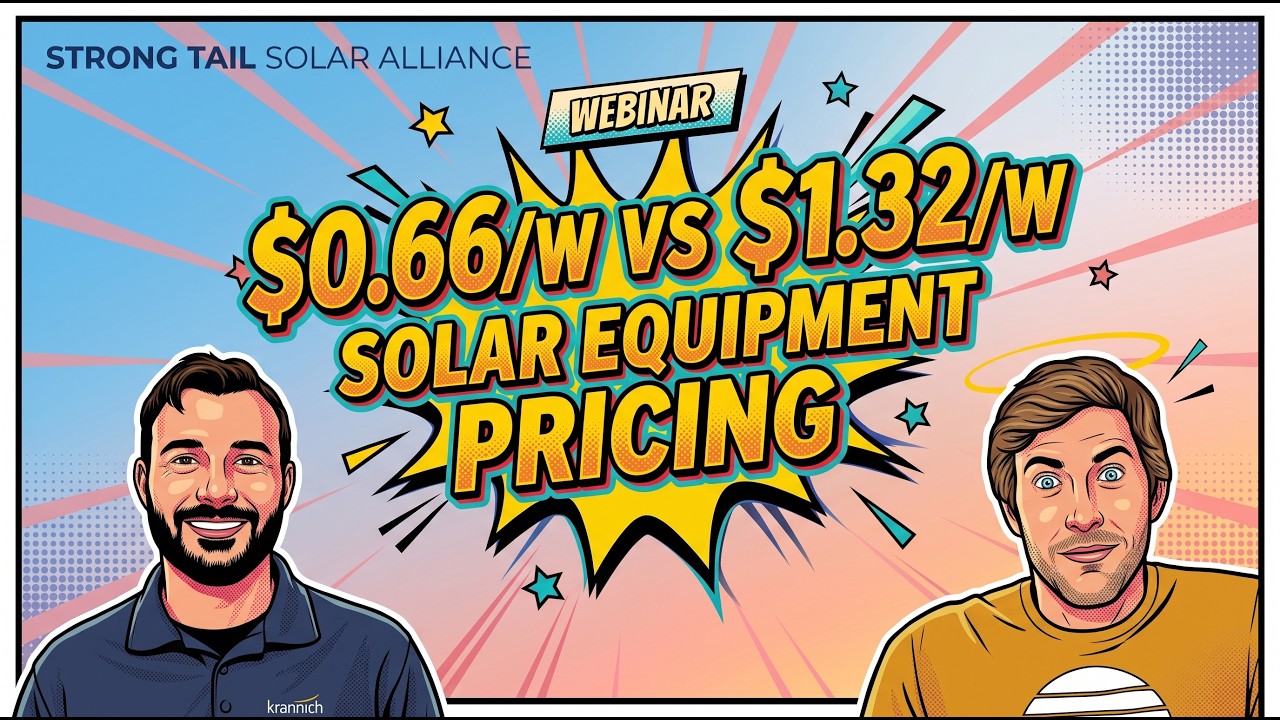
About 17 minutes into the our second Strong Tail Solar Alliance webinar: Navigating Pricing Power, Tariffs and Supply Chains, Joe Francolino pulled up the Krannich webshop and priced the same 10 kW job two ways. The cash/loan version, with JA panels, came to $6,600 in material. The version built to domestic content rules, the kind a lease or PPA company needs, came to $13,208. Same job, same size, twice the equipment cost.
Equipment is one of the biggest costs a local installer has, and it's about to get more expensive across the board. Starting December 4, new Section 232 tariffs put a price floor on imported solar modules, cells, wafers and polysilicon. Most installers we talk to know something is coming. Very few know how much, when they'll actually feel it, or what they can do about it now.
So we asked two people who see equipment prices every single day on our webinar Navigating Pricing Power, Tariffs and Supply Chains.
Moderator: Scott Nguyen, OneEthos and Bodhi
Panelists:
- Joe Francolino, Head of Sales, Krannich Solar USA
- Charlie Saginaw, Southwest Regional Sales Manager, JA Solar
We opened the webinar with a poll: what actually decides which module you buy? It came down to a tie between "whatever's cheapest per watt" and "a brand name the homeowner recognizes," and a couple of late votes broke it for cheapest per watt. Joe added a rule of thumb he's heard about homeowners: about 20% go with the cheapest option, 20% go top of the line, and the other 60% want great value somewhere in between.
What we covered
- The module gap is 20 to 25 cents a watt. That's what Charlie sees between JA panels and domestic content options like Qcells. Add the operational cost of keeping cash/loan jobs separate from TPO jobs, and he puts the real difference closer to 50 to 70 cents a watt.
- A live quote: 66 cents vs. $1.32 a watt. Joe built the cash/loan system with JA 440s at about 31 cents a watt through the Alliance, plus Tigo rapid shutdown and K2 racking. The domestic content version used Qcells 430s at 70 cents a watt and Enphase. Even knocking 10 cents a watt off the Qcells price, it's still $1.22 a watt.
- What that means for the homeowner. We ran both systems through our payment calculator. With the assumptions we plugged in, the Climate First Bank loan on the cash/loan system came to $153 a month, fixed. A standard 25-year lease on the domestic content system started lower at $141, then climbed to $286 a month by year 25 because of the escalator.
- Approved vendor lists cost you money too. Every TPO has its own list of approved SKUs. Charlie has seen installers switch financing partners and get stuck with modules and inverters that cost twice as much and don't fit the new partner's list.
- Section 232 sets a price floor. Starting December 4, imported modules have a minimum import price of 38 cents a watt, plus a 15% tariff. Cells, wafers and polysilicon have their own floors, so even panels assembled in the U.S. will cost more. Charlie expects modules that are in the low 30s today to be in the mid 40s by Q1 or Q2 of next year.
- Domestic content goes up too. Joe has heard estimates of an extra 7 to 15 cents a watt on domestic products in the short term, as manufacturers compete for the same limited supply of domestic glass and silicon.
- There's a soft landing, if you plan for it. Distributors will still have stock bought at the old price. Charlie expects that to stretch from December 4 to about January 30, maybe into February. Installers who just walk up to the counter could see the new price as soon as January 1.
What to do before December 4
We asked if this is like the run-up to the tax credit cliff last year, and Charlie said that was spot on. He's been in solar for 10 years, mostly in distribution, and he's watched installers race every deadline. This one works the same way, except what's going away is today's module price.
His first step is to list every customer you've already sold and work with your distributor to get those covered. Then forecast what you expect to sell in Q1. He also suggested showing homeowners an A and a B quote: "This is where we are now. This is where we'll be post Section 232. You decide."
Joe's advice was even simpler. Give your distributor a projection. "If you put a projection in and said, hey, I think this is what I'm going to need, I will fight very hard to keep that price exactly the same," he said. If you walk in on December 8th without one, you're getting the market price.
Watch the full webinar here
The full recording also covers the live quote screen share, where storage prices are headed (Europe's storage attachment rate is about 90%, compared to 5 to 10% here), and audience Q&A.
Join the Strong Tail Solar Alliance
Buying smarter is a lot easier when you're not doing it alone. Through the Alliance, JA Solar is offering up to 10% off modules for local installers selling cash/loan with Climate First Bank, which is how Joe got the JA 440 to about 31 cents a watt. Krannich is adding pricing on K2 racking and 10% off Franklin batteries. Members also get Bodhi's customer experience software free for approved installers, plus discounts from Scanifly and Damaris Solutions.
It's free to join. Fill out the form below and the right folks will reach out to you.